
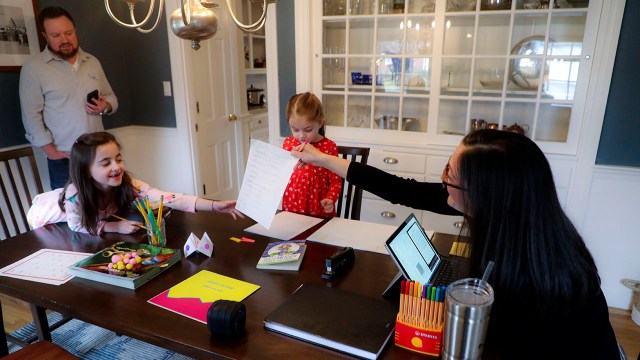
The coronavirus pandemic produced widespread youngster treatment challenges in the United States in 2020. People issues lasted into 2021 for some parents, according to a new Pew Investigate Center evaluation of governing administration details examining the way parents expended their time just before and during the outbreak.
When there was somewhat small improve in the sum of time mom and dad used right caring for their young children in between 2019 and 2020, the time they used on secondary youngster treatment – that is, supervising their kids even though performing other matters, these types of as performing, accomplishing chores or viewing television – went up significantly.
And the greater time motivation on secondary care persisted into 2021 for one team of mothers and fathers in specific: mothers with children ages 5 to 12, according to the investigation, which seems to be at time use data masking the 2019-2021 period of time.
This Pew Exploration Center evaluation is centered on data from the American Time Use Study masking the 2019-2021 period of time and conducted by the Bureau of Labor Figures (BLS). Microdata employed in this examination arrives from the Built-in Public Use Microdata Sequence (IPUMS) provided by the University of Minnesota.
The analysis focuses on the time married and partnered moms and dads put in on secondary baby care, which the BLS defines as situations when dad and mom had at minimum a person baby underneath age 13 in their treatment even though doing actions other than most important kid care.
The sample utilized in this analysis involves married and partnered mothers and fathers with minimal kids dwelling in the home. For the reason that secondary treatment is only noted for youngsters underneath 13 yrs aged, we only carry secondary treatment estimates for moms and dads whose youngest child is young than 13 yrs old. Entire-time performing mom and dad are folks operating 35 several hours or extra for each week. Eventually, for the reason that American Time Use Study data collection was interrupted all through portion of the initially semester of 2020, we only use details from the 2nd half of 2019, 2020 and 2021.
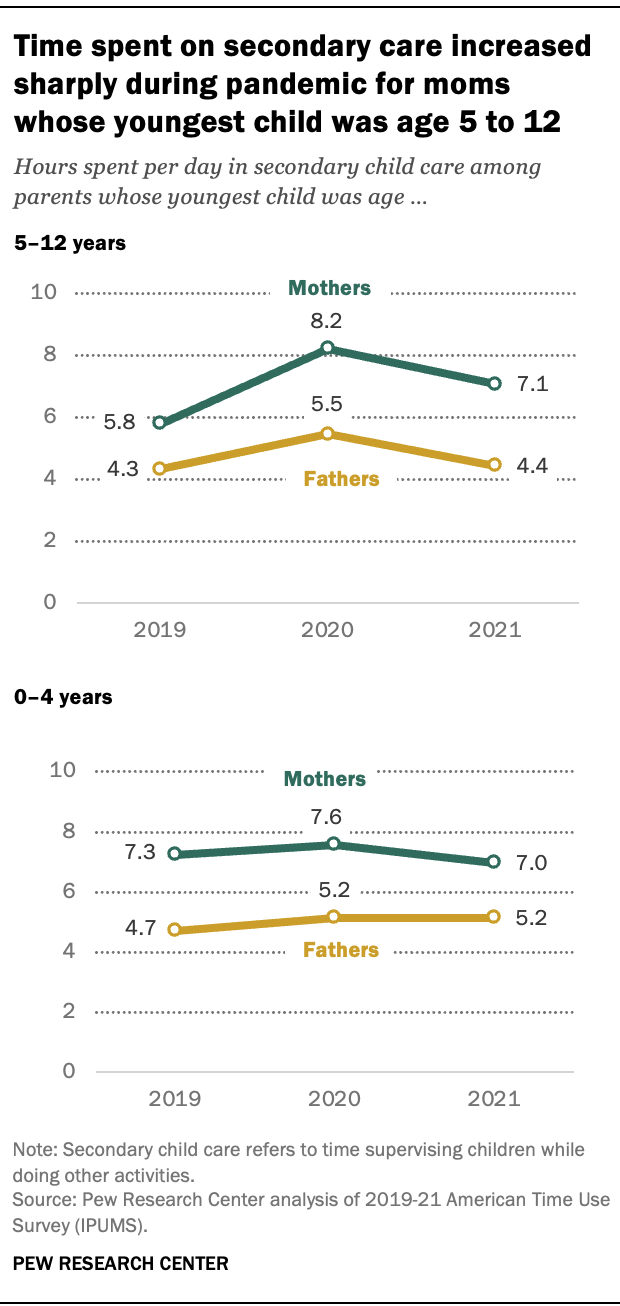
For moms whose youngest baby was age 5 to 12, average time expended on secondary treatment elevated by about 2.5 several hours from 2019 to 2020, from an normal of 5.8 to 8.2 hrs a day, in advance of dipping to an regular of 7.1 hours a day in 2021. The 2021 average was nevertheless considerably higher than prior to the onset of the pandemic, even as other aspects of life began to normalize in the outbreak’s second year.
Moms with a youngest kid age 4 or young, by comparison, did not see a statistically substantial raise in the time they expended on secondary kid treatment in the 2019-2021 period.
As has very long been the circumstance, there are sizable gender discrepancies in the amount of money of time that dad and mom expend on baby care. These patterns continued in 2020 and 2021, with fathers expending significantly fewer time than moms on both equally key and secondary baby care.
Among the fathers with a youngest boy or girl age 5 to 12, time in secondary treatment enhanced 1.2 hrs from 2019 to 2020. Even so, for fathers whose youngest boy or girl was 4 or more youthful, time in secondary kid care remained steady in this time span.
As a total, mom and dad with children younger than 13 noticed an maximize in time expended on secondary care in the to start with calendar year of the pandemic. In 2019, fathers with young children 12 or below used an average of 4.5 hours on secondary boy or girl care. Fathers’ time enhanced to 5.3 hours in 2020 and then moved to an average of 4.8 hours in 2021. On average, moms spent 6.5 hours for each working day on secondary care in 2019, 7.9 hrs in 2020 and 7. several hours in 2021.
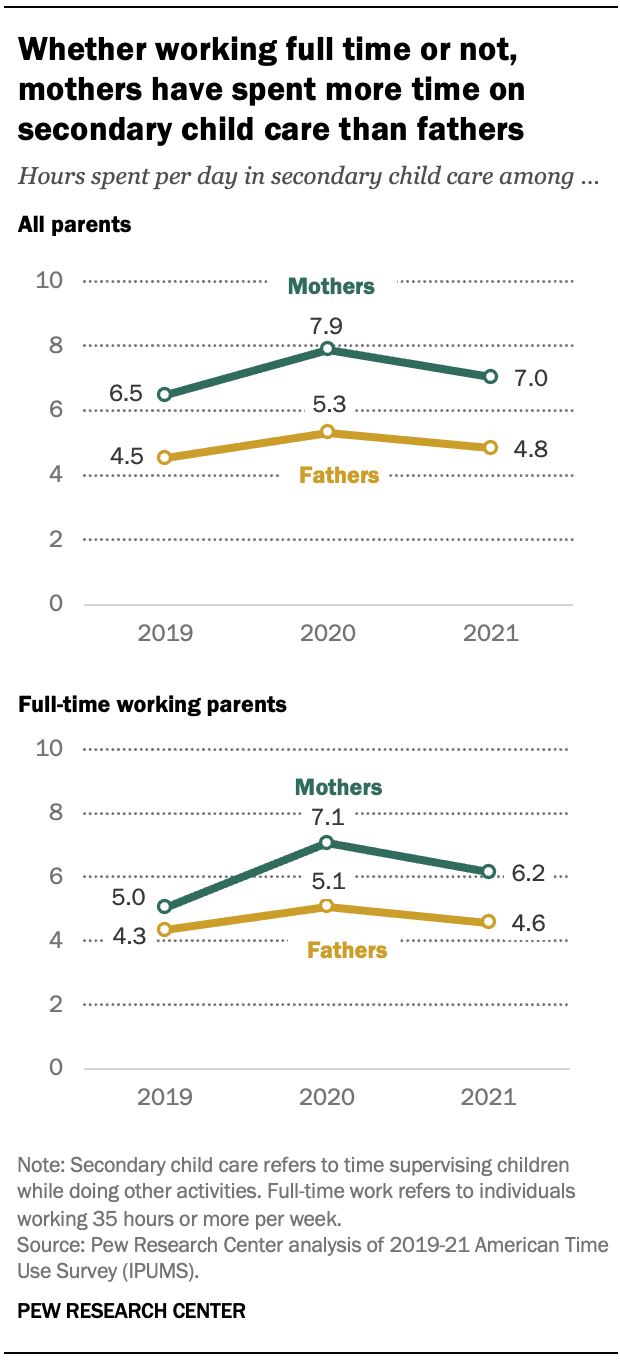
In general, comprehensive-time working mothers and fathers expended a lot less time on secondary baby treatment than mom and dad who do not function whole time. For complete-time doing the job fathers, the amount of money of time put in providing this type of care stayed rather steady from 2019 to 2020 and again from 2020 to 2021. Full-time working mothers, on the other hand, saw an raise through the initial 12 months of the pandemic (from an typical of 5. to 7.1 hours for every working day) and then a craze back down in 2021 (an average 6.2 hrs).
For many employed mother and father, the shift to distant get the job done – together with interruptions in working day treatment and schooling – likely contributed to the improved time they put in all through the pandemic on secondary boy or girl care.
Other analysis has shown an boost in the quantity of time moms put in doing work although supervising their children in the first calendar year of the pandemic, and the gender hole concerning mothers and fathers in this variety of time use became considerably wider. These overlapping requires may possibly support account for the extra burden mothers have expert above the previous couple of years.
Carolina Aragão is a investigation affiliate concentrating on social and demographic trends at Pew Research Middle.